Wednesday, January 28, 2009

Protecting Tomorrow...

According to a research done by Life Insurance Association of Singapore in 2006. The average working Singaporean needs roughly $480,000 of Insurance Cover but has just a quarter of that or $118,000. From this survey, 3 hard facts were identified.


1) Majority of Singaporeans who own life insurance policies do not have sufficient coverage to protect their families and loved ones.
2) About a third of Singaporeans underestimate the amount of protection that is sufficient and more than a thir had no idea who much is considered adequate.
3) While many understand that insurance is important, they do not see see it as an urgent necessity.

What are the common excuses Singaporeans have for not getting an insurance plan?
1) Not free. Very busy... Call me next time... (The next time will never comes)
2) I know when I need it... Don't need to worry... (Its probably too late when you need it)
3) Call you when I'm interested... (I don't think insurance will ever interest them)
4) I have enough policies... (Don't know how they guage if they have enough)
5) I have an agent already... (Don't know if the agent really do a proper Financial Plan for him)
6) I can invest and save better... (Probably punting the money in the stock market)
7) I don't have money. Budget very tight... (Some people have hundred of thousands in their bank and can tell you "I don't have money to buy insurance")

Through my experience, few people will wake up and remind themselves that they need to do a financial review. Its not like a doctor or dentist where people will visit when they are physically sick. How many people think they are financially sick? Its probably at the back of their mind, but they need someone to push them a little bit in order that they action.


Sunday, January 25, 2009

The Festive Season

I was chatting with my colleague recently until a question popped out. "What is the difference between a Bull and an Ox?". There was so much of guessing game until we decided to check out the Internet for an answer. We concluded that Bull is an uncastrated adult male of a cattle and an Ox is a casatrated bull which are normally meant for domestic purpose such as farming. The chinese use Ox for farming and not Bull and hence they named it the year of Ox and not the year of Bull. Well. This is for your Information about why Ox was named and not Bull...

As a child, I like Chinese New Year because I get to receive lots of Ang Baos and have fun playing cards with my cousins. After Marriage, I kinda feel tired when it comes to Chinese New Year. I got to spend two full days doing spring cleaning of the whole house, I got to squeeze through the Causeway back to Malaysia, I got to spend a sum of money to give out Ang Baos and I have problem meeting with any clients during this period when they are busy with their CNY celebrations.

This year shall be a challenging year for me. I have to redefine my work, prioritize my time and be more selective with my clients. I had spent too much time doing administrative work like claims, premium collection, on policies like Travel and Home Insurances and on people who will ask thousands of complicating questions but never do anything. I really felt very sorry for leaving my beloved wife at home alone most of the nights. Our relationship will be strained, no matter how close we are, if this going to carry on.

Thats why on her Birthday on 19th Jan, I treated her to a sumptous Japanese Buffet at Himawari (Telok Blangah). We went to many Japanese Buffets and this is one which I strongly recommend. Very value for money and the quality is good. On 18th Jan, I invited her parents to our place to celebrate her Birthday and to BBQ in Pasir Ris and on the 20th Jan, I gave her a surprise by sending a banquet of Tulips to her office. So she actually celebrated her birthday for 3 days...

Thank you, my dear, for supporting me in this industry. Thank you for ironing all my long sleeve shirt. By wearing them, I look smart and tidy in front of my clients. I promise you to work hard and smart this year. Thanks for always believing in me...

Oops. I just forgotten that its Chinese New Year today... Wish all of you a very Happy Ox Year and may all your wishes come true...

Thursday, January 22, 2009

The desperately needed leadership

It was 20th January 2009 when Barack Obama was inaugurated as America 44th President. Wearing a navy suit and red tie, Obama repeated the oath of office, his hand on the same Bible used in President Abraham Lincoln's inauguration on 4th March 1861 as the 16th President. Abraham Lincoln entered office in a crisis when America is fighting a Civil war. He was regarded as one of the greatest US president, not only leading the country out of Crisis but drove Slavery out of America.

Barack Obama entered office also in a Crisis. The world are expecting change desperately. They need the leadership and the confidence to get out of this crisis. I watched the inauguration on Channel News Asia and felt very touched with his speech. He sort of became an idol to me.

Obama promised his people 3 million jobs saved or created within 2 years and outlined an agressive stimulus package worth US$825 Billion in his country. Do you know what package is it? His plan has six components. Let me share with you.

1) Double alternative energy production in three years
$32 billion for a "smart electricity grid."
$20 billion in renewable energy tax cuts.
$6 billion to weatherize homes.

2) Modernize federal infrastructure
$32 billion for transportation
$31 billion to modernize federal buildings.
$19 billion in water projects.
$10 billion mass transit projects.

3) Improve health care
$39 billion to subsidize health care insurance for the unemployed.
$90 billion to help states with Medicaid.
$20 billion to modernize health information technology systems.
$4 billion for preventative care;.
$1.5 billion for community health centers.

4) 21st century education
$41 billion to school districts.
$79 billion to states.
$21 billion for school modernization.
$16 billion to boost the Pell Grant.
$2 billion for Head Start.

5) Invest in science research and technology
$10 billion for science facilities
$6 billion to expand broadband.
$1 billion for the 2010 Census.

6) Relief for Families
* Cut taxes by $500 for individuals and $1,000 for families.Tax cuts would be retroactive to 2007, and rebates would be mailed in Q1 2009.
* Greater access to child tax credit for working poor and expand earned-income tax credit to families with three children. A $2,500 college tuition tax credit. Allows first-time homebuyers to keep $7,500.
* Keep extended unemployment benefits through 2009 and provide job training.
* Increase benefits to the poor by $25 billion.

Data Summarised from:
Well. Hope his presence shall inject confidence and the recession be over soon...

Sunday, January 18, 2009

The Paradox of Thrift

Our Senior Minister Goh Chok Tong said the below during his Grassroot event on 6th Nov 08. His likely intention is to help boost confidence among Singaporeans to continue spending money in times of recession...

** Quote **
“If all of us go into a power save mode, then the economy will really go into a recession! This is what economists called the Paradox of Thrift. If you have sufficient savings and can afford to spend, you should continue to spend on life’s little pleasures.
“Take your family to the movies, shop, dine out at restaurants and hawker centres, go for your regular foot massage, indulge yourself at a spa, take a taxi, donate to charity and so on.
“This way, we keep the economy going. In fact, I would say when times are a little slow, you could get the best bargain.” - Senior Minister Goh Chok Tong.
** Unquote **

From Wikipedia, I found the following to explain Paradox of Thrift:

The paradox of thrift is a paradox of economics propounded by John Maynard Keynes. The paradox states that if everyone saves more money during times of recession, then aggregate demand will fall and will in turn lower total savings in the population. One can argue that if everyone saves, then there is a decrease in consumption which leads to a fall in aggregate demand and thus leads to a fall in economic growth.

In simpler words, it means that if we saves more money, the total revenues for companies will decline. This decrease in economic growth means fewer salary increases and perhaps downsizing. Eventually our total savings will have remained the same or even declined because of lower incomes and a weaker economy.

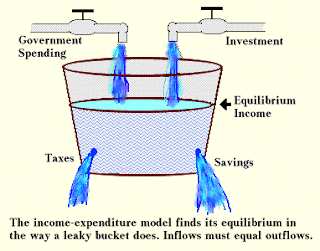
Another simple way to explain is by using an example of a leaking bucket.

* In a leaky bucket, an equilibrium level of water occurs when the leakage just equals the inflow of water.
* In the multiplier model, investment and government spending are inflows
* Taxes and expected saving are leakages
* When leakages increase and inflows remain constant, the level of water will be reduced.


When I read through the comments in "Onlinecitizen.com" website http://theonlinecitizen.com/archives/2765, many people are urging the government to give them money or cut tax like what Obama is expected to do in US. Obama articulated the opinion that "Only government can break the vicious cycles that are crippling our economy – where a lack of spending leads to lost jobs which leads to even less spending; where an inability to lend and borrow stops growth and leads to even less credit."

Many believe that in a financial crisis, the best way to get the economy moving is for the government to "prime the pump" by putting money in the hands of consumers.

The US goverment have to prime more money in because the people in US actually don't have much money. They are highly geared as compared to the Asians. They don't have much savings but still need to spend to keep the economy going because internal consumption take up probably 60% of their economy. If all spending stops, more companies will go bankrupt and more unemployment to come.

But of course, priming money doesn't means giving out money all the time, it can be in the form of tax cut or increasing government expenditure and investments, etc. All these will increase the already ballooning deficit faced by the US Treasury. Nobody knows if Obama's plan will works. Just pray hard that it will or else the global economy will continue to stay down for a long time to come.

As for the consumerism story in Singapore, I think that the "Paradox of Thrift" doesn't apply much here because we are largely a service and manufacturing base compared to the US. The challenge of our government to ensure Singapore stay competitive and as many Singaporeans retain their jobs for as long as possible before the economy turnaround.

Many companies get their projects and contracts secured during times of good economy and managed to save for rainy days. They probably hold retrenchment plans till the last of the project are completed. If the recession stay longer than expected and new projects are not secured, Singapore will be in deep trouble.

Thursday, January 15, 2009

The 3 Skills needed in the Financal Advisory Industry

3 skills are needed in order to lead a meaningful career in the Financial Advisory Industry. If we apply these skills on the correct market, coupled with the right process, success will be in sight for us. I'm currently trying to master the 3 skills and at the same time finding the right group of people to serve. So what are the 3 skills I'm talking about here?

1) The Core skills of acquring knowledge
* A Financial Planner needs a lot of knowledge before he can complete a proper financial plan
* He need to be kept updated of many news around the world, investment opportunities, new insurance plans, etc
* He need to know where to acquire the right knowledge in order to strive and grow. Formal learning such as acquring his CFP, keep reading and going for countless seminars, be humble and learn from others as well as teaching and coaching others.
* My blog itself is like another avenue for me to learn because I learn as I teach and write for other people.

2) The Life skills that apply to yourself
* A Financial Planner needs to be continually motivated and positive.
* I was being trashed and insulted during my journey of being a planner. In a recently case, I was being described to be a monkey just because I recommended unit trust portfolio to a prospect I know through my blog. He said that Fund managers cannot do better than a group of monkeys picking stocks and I'm just another monkey trying to add another layer of cost from him.
* Well, he is not entirely wrong but deep inside, I know there are people who need me and I'll stay on to earn my wage in an honest and ethical way and NOT through monkey business.
* If I believe that I'm a monkey, I will have resign long time ago.

* A Financial Planner need to be very self disciplined. He need to wake up on time to work and do the necessary work inherent in the whole Sales and Advisory Cycle. People do not wake up and call you to buy an insurance or investment plan, we somehow need to call for people and work hard for the next referral.
* For a planner who sell plans with lower commission, he need double the volume, double the dose of passion to work and doubly hard for half the income a normal adviser earns.

3) The soft skills towards other people
* Its useless if you have all the knowledge, be very disciplined and hardworking but people simply don't trust you.
* We need the right communication skills to convene the message to our clients. We need to show clients that we are the pilot of their money and we are able to bring them to the right destination.
* We must impart confidence so that they will act on something. A financial plan is useless if we cannot convince our clients to act on it
* We need to be connected with their heart to gain such trust and confidence. To make it simple. That person must simply like you...

If I'm going to rate myself in term of the 3 skills. I think I can get 7-5-4. I'm not very disciplined in my prospecting and too comfortable with my current group of clients. I also need to improve on my soft-skills. Many people find me to help them with a Financial Plan, but I always can't convince them to take action. Obviously, I'm not convincing enough...

Sunday, January 11, 2009

Looking for a good PA Plan

In my last posting, I mentioned the benefits of having a Personal Accident Cover. It was also highlighted in the comments that it is by no way to replace coverage against death because death can happen due to both accident and sickness.

For those looking for a Personal Accident Cover, I can share a few tips in how I select coverage for my clients.

1) Get a plan that forcus on the core coverage
* Some covers in a PA plan, in my opinion, are not very necessary. When such covers are added in the PA plan, it adds up to the premium.
* What are the common things which I feel are not so necessary
a) Hospital Benefit - If you need this cover, get one which covers accident and sickness. Covering accidents only is not good enough, so no point getting this.
b) Emergency Evacuation - When we go overseas, we usually get a separate Travel Insurance which normally also cover emergency evacuation.
c) Recuperation Benefits, Bereavement Grants, Lifestyle maintenance, etc... They are simply extra benefits to the total sum assured. If you are covered for $100k, why so concern about the extra $5k or so?

2) Look into the definition of an Accident
* Some common Definitions of Accidents
a) Bodily injury caused by violent, accidental external and visible means which is the sole cause of death or disablement or which necessitate medical or surgical treatment
b) Sudden, unforeseen and fortuitous event that results in the insured person suffering death, disablement or injury
c) an event which happens suddenly and gives rise to a result which the Insured person did not intend or anticipate
* First definition is the worst of all. It is very restricted with its definition. I'm not sure if I'll be covered if I die in a fire by fume and not fire or if I die through food poisoning, etc. The 2nd and 3rd Definition remove such restrictions.

3) Check out if your PA plan covers the below:
a) Terrorism. Some insurers covers but put some terms and conditions applies in it.
b) Motorcycling whether its rider or pillion. Don't take chance. You never know when you may need to ride a motorcycle and your family be shock that your PA plan don't cover motorcycling.
c) Certain hazadous sports, such as Scuba Diving, Rock-climbing or Skiing even if its for leisure when you go holiday.
d) Dengue Fever. Some Insurers covers for Insect bites but not for Mosquito bites such as Dengue Fever. Watch out...
e) Traditional Chinese Medicine. Some insurers did not mention anything about TCM. They may or may not pay but they rightfully can refuse to pay you if you visit them.

4) The premium rates
a) Some insurers imposed the same premium rate for Class 1 and 2 occupations. For those in Class 2 occupations, you might be able to get very good rates from them.
b) For a $100k cover, you normally need not pay more than $10/mth. Many PA plans purchased through Credit Card telemarketers normally charges at least $20/mth.
c) Some companies charge you double and promise a 50% refund of premium after 5-6 yrs. I'll rather than you pay less and save up the rest of the premium yourself than to tie yourself with that insurer for 5-6 yrs.
d) Some insurers gives free coverage for children when both parents take up their PA plan. For those with 3 children and above, its a very good free cover.

Have fun shopping for a good deal... but remember that the cheapest or the most expensive plan doesn't always mean the best.

Friday, January 9, 2009

Why Personal Accident Plan???

Most people took up a Personal Accident plan via telemarketers, Credit Card complement or through their company's corporate insurer. An adviser who do not do proper fact-finding may miss out recommending a PA plan. It is understandable that few advisers like to recommend a PA plan largely due to the low premium, low commission and the high chance of claim.


Many people do not have such a low cost policy because they did not hear about it or has misunderstood its coverage. It will be quite unfortunate if an accident strike and they are not able to claim things that are unique to a PA plan. Today, I like to share why its important to have a Personal Accident Plan.

1) Beefing up Death Coverage at low cost
* 6% of Singaporeans die of Accident in 2007. It is not a big number compared to Cancer and Heart Diseases but I believe the chance that a young man dies via accident is higher compared to sickness.
* And it is usually that young man have a higher dependency needs when they are likely to be under-insured.

2) Covering Accidental Permanent Disablement
*A person’s life have a certain value attached which are determined by his dependency needs. Likewise, a person’s hand, leg or eyes should have a value attached as well.
* If a person loses a leg, eye or finger permanently, he is likely not able to claim for any of his policy.
* The chance that a healthy person loses a finger, hand or eye is largely via accident.
* Example. Full Sum Assured $100,000. Loss of one arm = 50%, Loss of one finger = 8% x $100k.

3) Accident Medical Reimbursement
* A person may not be admitted to hospital upon meeting an accident because an accident may not necessary means a major road accident or work place accident, etc. It can be a simple sprain during house moving or a bad cut during cooking, etc.
* Such incident may end the person up in hospital A&E or just the neighbourhood clinic or even the Traditional Chinese Medicine Clinics. Such expenses may come up to as much as several hundred dollars.
* Post Accident visits to Physiotherapist, Chiropractor, Osteopathic Practitioner, Bonesetter or even Acupuncturist might even cost you few thousand dollars if they are not serious enough for one to be hospitalised.

4) The other "Good to have" covers
The 3 items above the are core coverage, but there are many sub-coverage which many accident plans include. The rest are good to have but usually not critical.
a) Daily Hospital Benefits or Weekly Disablement Benefits - Allows you to claim $XXX amount per day in hospital or per week of disablement. Good coverage for those self employed people.
b) Mobility Aid Reimbursement - Allows you to buy mobility aid such as Wheelchair, clutches, etc
c) Ambulance services - Allows you to claim against Ambulance expenses as a result of an accident.

Well. In my next posting, I can share the tips in selecting a good PA plan.

Sunday, January 4, 2009

Fund Managers Skills

Fund Manager need 2 skills to outperform the market.
1) The skill of forecasting price movements of selected stocks. It is best described as "Security Analysis" or simply "Stock Picking"
2) The skill of forecasting future economic conditions and adjust portfolio systematic risk. This is best described as "Market Timing"

Many people only looks at the returns of their fund to guage if they are investing well and not comparing this returns to anything else. I think this practice can be improved by looking into some technical aspect of the fund.

So what are the technical areas we can look into when we analyse fund managers? With my limited knowledge, I can share 5 simple and more reader friendly ones.

1) The Annualised Returns
* The absolute returns of a fund above 1 year are first annualised and compared with the benchmark and peer funds.
* If the fund outperformed the benchmark, we can say that it had generated excess returns over the period. 1,3 and 5 years of returns are normally used.
* Thereafter, we use the figure to compare between fund managers. Its like a soccer league table where we see who top the table for each category.

However, by knowing returns alone are not sufficient, we have to know the type of risk the fund manager is taking in order to generate this excess returns.

2) Fund's Beta
* Beta is the primary measure for market risk of an investment. It measures the volatility of an investment in relation to the overall market. The overall market has a Beta of 1. A beta above 1 is more volatile than the overall market, while a beta below 1 is less volatile.
* For example, if a stock's beta is 1.2, it's theoretically 20% more volatile than the market.

3) Standard Deviation
*Another way to see the level of risk a fund manager take is by looking into the fund's Standard Deviation.
* Standard deviation is a statistical measurement on historical volatility. For example, a volatile stock will have a high standard deviation while the deviation of a stable blue chip stock will be lower. A large dispersion tells us how much the return on the fund is deviating from the expected normal returns.

After understanding Returns and Risk, we need to combine both to evaluate if the fund manager is really doing fine.

4) Sharpe Ratio
* William F. Sharpe developed the Sharpe Measure in 1966 to evaluate portfolio performance. His idea was to measure the amount of excess return of the portfolio over the risk-free rate in a given period per unit of risk.
* It indicates the excess return that the fund manager can deliver to investors for each unit of risk the fund manager took. Hence, the higher the Sharpe ratio, the better the investment's performance.

5) Fund's "Alpha"
* It measures the difference between a fund's actual returns and its expected performance, given its level of risk (as measured by beta).
* A positive alpha indicates that the fund has performed better than its beta would predict. In contrast, a negative alpha indicates a fund has underperformed based on the risk it had taken.
* A fund manager always strive to achieve positive alpha consistently.

The ratios that can be used are exhaustive and the above are very basic ones. Many other ratios such as Information Ratio, Jenson Ratio, Tracking Error, R Squared, etc are not mentioned. Frankly, I'm not an expert is these as well and certainly not good enough to conduct a class on them.

We are nevertheless fortunate to have Investment Information Providers such as Morningstar and Lipper to help group fund managers' ability according to their methodology which partly use these ratios.

Thursday, January 1, 2009

2009 Resolutions

This is my first posting of 2009 and as usual, I shall write about my resolutions.

I was at Vivocity with my wife for the countdown party by Channel 8. Both of us managed to get into the section where all the fans of the celebritites are. It was the one of those front seats and we have a lot of fun with these fans.

We left shortly after the countdown and reached home at around 1:30am. I'd prepared a soft cuddly teddy bear for my wife to welcome her 2009. I have big problem remembering what I bought for her over our 6 years together. Maybe I can make use of my blog to help me remember all these.
****************
After the countdown, I was quite lost over my 2009 resolutions. I was so busy with work over my last 6 months that I only worked on what I see forward. Its like taking a step at a time.
After sitting quietly in front of my computer over the last 3 hours, I had carefully set out my 2009 resolutions?

1) Health
* To be careful with my nutrition. Less oily and fried food. Less chocolates and sweet stuffs.
* I shall sleep and wake up early everyday for the benefit of my health
* To take care of my back and strengthen my back muscle to prevent future sprains again.
* To be a healthier Adrian and able to take care of others who are sick.

2) Physical Well Being
* Be disciplined with my exercise Regime. Twice Gym, Onces jogging or swimming weekly.
* To participate in the annual Army Half Marathon somewhere in Aug or Sep
* To be a stronger and energized Adrian
* IPPT Gold in 2009. Tall order but must try...

3) Career
* Consumers are getting more demanding and knowledgeable but wanting to pay less for adviser's help.
* Its tough but I still find this job one of the most meaningful and fulfilling. I'm enjoying myself and I will continue touching lives to people around me. I assure that I will continue to give my clients the best value possible and be honest with my views. Definitely no career switch...
* I may take up some courses relating to my work. Not decided on which yet.

4) Money
* I don't earn much but I will still spend to understand what life is about. I will dine and holiday in 2009 but maybe through budget tours.
* I must pay tax in 2009 to help the Singapore economy. To pay tax, I probably have to earn at least $30,000 after operating expenses and reliefs.
* Stick to my disciplined savings/investment regime meant for my retirement.

5) Family and Social
* I must try contact all my friends in Secondary Schools, Polytechnic, University, Ex-colleagues at least once in 2009. To say hello and get to know how they are doing.
* To be closer with my parents. Apart from the weekly dinner and my Christmas dinner, I aims to treat my Mum, Dad and Grandma good meals outside more often.
* Kids? Let God decide for me. Not really planning but not preventing. Not attracted by the freebies the govt give. A bit of probia. Probably worried of the insufficient money and lifestyle change.
* I will select a charity and to contribute 5% of my income in 2009.

Well. I think my resolutions are specific and measurable. Today's New Year energy gives me today's resolutions. After that, it’s up to me how things will continue. I shall do what matters most and not taking on more than I can handle. In 2010, I shall review them again. Wish me good luck...

Wednesday, December 31, 2008

Review of 2008


Review of my 5 2008 Resolutions as per my 1st Jan 08 post

1) To achieve stablised income of $3,000/mth or $36,000/yr

* Due to my switch of career, my average income in 2008 is probably only around $1,000/month at the moment
2) To pass CFA Level 1 examination
* I did not pass my CFA in Jun08 and I have no time to retake Dec08 exam
3) IPPT Silver in 2008
* I got my IPPT Silver in August 08
4) Gain weight from 58kg to 62kg thru weights training
* I did nothing at all to make me a stronger person till December
* I think I gain more fats than muscles
5) Toastmasters Competent Communicator
* I drop out from Toastmasters after leaving NTUC Income and I did not join any club

What I feel about 2008?
Health
* No major illnesses except for occasional back pains. I did not exercise much in 2008 and I can feel my energy level dropping.

Career
* I made a career switch in Jun08 to join a Financial Advisory Firm. I lost my clients and commissions overnight and start earning from zero. A lot of time are spent learning and unlearning.
* No regrets in getting out from the tied agency system but a bit of miscalculation by joining a firm whose remumeration system gives better benefits to top advisers and managers. I have no intention to be a manager yet. Perhaps in 2010.

Money
* It took me nearly 4 years to start earning a stable income of $2k/mth and now I started with $0 again. Thats the problem in our profession. We give up our salary when we leave for new firm.
* I'm currently on negative cashflow position. I have been through this stage before and I'm confident to be back in the black within 1 year. Things will only get better.

Lifestyle
* Still okay. Not much time for friends nowadays except for occasional wedding dinners and house warmings
* Cannot work like my unmarried or unattached colleagues. My time are divided equally between work and family now.

Family
* My wife gives me a lot of support. She understand my philosophy in Financial Planning and believe that I will do well one day. I love her and I will not fail her.
* Kids? I have a probia for one. Don't ask me why? Maybe because I worry about insufficient time and money.

I shall write about my Resolutions tomorrow...

Monday, December 29, 2008

Developing your Financial Plan

As Financial Planners, we help our clients in developing a Financial Plan. Many people have no idea what a Financial Plan should constitute. Some of them demanded more complicating stuffs from us and disappointed on how simple it can be. Our roles are not well defined and often misunderstood.

* Financial Plan is not Rocket Science that comes with complicating formulaes. We are not Financial Engineers.
* Financial Plan is not about helping you make lots of money and to analyse all your stock holdings. We are not Financial Analyst.
* Financial Plan is not about scrutinising every stocks in your Unit Trust and answer why was some shares selected. We are not Fund Managers.

If a Financial Plan do not help us analyse all these and let us make lots of money, then why need a Financial Plan?

My work desk and unpresented Financial Reports

I always consider myself more like a Financial Counsellor and not a Financial Professor with complicating formulaes to impress others. My role is to guide my clients in a structured way towards managing their finance and to ensure that they are disciplined enough to hit their financial goals. We are also like cheerleaders, cheering and encouraging them to be focused on their goals through our regular reviews.

So what are the considerations that we, as Financial Planners take when we construct a Financial plan? I can share 10 basic things that I do for my clients.

1. Understanding client’s needs, short/mid/long term goals and priorities
2. Gathering relevant quantitative and qualitative data
3. Hearing first hand on client's problems and concerns and record them into their individual file
4. Informing clients on assumptions used in the Financial Plan and when a review is necessary
5. Analysing Client's Net Worth and Cash Flow
6. Using basic Formulas to guage Client's Financial Health
7. Looking through Client's current Insurance policies and assist them with knowing their insurance numbers. (Hospitalisation, Death, Disability Critical Illnesses, accidents, etc)
8. Understanding Client's Investment Strategy and Philosophy
9. Understanding Client's Retirement needs and if on track with current strategy
10. Income Tax and Estate Planning considerations

After the Financial Plan is completed, we'll proceed with Recommendations and the Implementation process. As FAs, we have another layer of job which is to identify the plan with the best value from the range of companies we represent. Last but not least, Our job is also in reviewing the financial plan as an on-going service.

A Financial Plan is normally not complicated but tedious and time consuming to construct. We recommend according to needs and earns a modest living when we recommend plans of good value for our clients. Majority of us earns a commission and it is a way to compensate our time.

For me, I do more on Simple Cases and I cannot have differing standard as of who I shall charge a fee and who shall not. For simplicity, I keep to one system for the moment.

Friday, December 26, 2008

The Need of Discipline and Convenience

I walked into the California Gym 2 months ago to ask about their Gym membership package. I thought of starting 2009 with a disciplined exercise regime.

Many friends tell me not to sign up because it is cheaper in Sport Councils where it cost only $2.50 per entry and that I can do my own weights exercises and jogging myself to keep fit. Its not necessary to sign up a Gym Package.

I know about the lower cost in Sports Councils and that I can do my own exercise at home but the thing is that “I never do it despite the low cost of keep fit”. My usual excuses are the lack of convenience and discipline.

* To overcome the convenience factor, I had chosen a gym within walking distance to my office and rented a personal locker in the Gym to put my clothes, shoes, bathing stuffs in my locker. I don’t need to bring all these barang barang now compared to the times when I go to sports council.
* To overcome the Discipline factor, I had asked my colleagues to join me so that we can encourage each other. The thought of putting in money monthly will also ensure that I fully make use of their services. This shall motivate me as well.

I eventually sign up the package without waiting for 2009. I'm currently going Gym on a regular basis and I must try to keep it this way...

*********************
This incident reminded me of my investment plan.

In the past, my investment discipline was through setting aside my monthly surplus and target to buy ETFs and shares every 3-4 months because of the lower cost structure compared to Unit Trust.

I encountered a few problems with this way of investment
1) It take rather long before I can accumulate enough money to get into ETF and shares at reasonable cost. I normally buy only after I accumulate $3-4k.
2) I also realized that I do not have the discipline to save because I spend more when I have more money.
3) After accumulating that $3-4k, I become fearful with my money that I will lose it. I was very emotionally with this money and start to punk the market, hoping for quick returns.
4) I become greedy at the height of the bull market like many investors and I got myself burnt with my investments.

To control my greed and lack of discipline, I decided to adopt a very simple and convenient way of investment called RSP (Regular Savings Plan). In the past, I failed to target an amount to save and I tend to spend more when I have more money. With a Unit Trust RSP, I forced myself to invest $XXX/month without trying to time the market. I spend only after setting aside the money for investments.

My investment plan is somehow similar to my new exercise regime. I need the Discipline and Convenience to achieve my fitness target. I also need this Discipline and the Convenience of RSP to achieve my financial target. The cost of Unit Trust is slightly higher and potential returns are smaller compared to the stock market, but it suits me well.

To start an RSP is simple and the cost is reasonable. I strongly encourage you to start one. Don’t need to wait so long!!!

Tuesday, December 23, 2008

Incontestability Clause

I was recently asked about the Incontestability Clause by one of my client. Below is my reply to him...

xxxxxxxxxxxxxxxxx

Hi Mr XXX,

Below is the actual wording from the i-term Policy Document with regards to incontestability

***
2. INCONTESTABILITY
After one year from the Date of Issue or from the date of reinstatement, whichever is later, this Policy shall be incontestable except for fraud or non-payment of premiums.

***

This clause is to prevent the insurer from contesting or disputing the validity of the policy except on grounds of fraud or non-payment of premiums after policies have been in force for at least one year from the date of issue or date of revival.

The purpose of the incontestable clause is to protect the beneficiary if the insurer tries to deny payment of the claim years after the policy was first issued. This is because the insured will be dead and he or she cannot refute the insurer's allegations. As a result, the beneficiary could be financially harmed if the claim is denied on the grounds of a material misrepresentation or concealment.

I have not heard of any legal case with regards to incontestability in Singapore but in my opinion, the insurance company has to prove that there is fraudulent intent, in order to reject a claim after 1 years if they choose to reject a claims.

Fraud is a false representation calculated to deceive another into acting against her or his legal interest. Statements that are inaccurate but made without the intent to deceive are not fraudulent.

Hope my info helps with regards to incontestability. Thanks.

Brgds
Adrian Khiat

xxxxxxxxxxxxxxxxx

Friday, December 19, 2008

Another close comrade passed away

I write this because 2 close ex-colleagues, coincidently by the name of David, passed away during the past 1 year. Both of them coincidently also joined NTUC Income with me, though different departments.

I joined NTUC Income as a full-time adviser on 1st March 04. A colleague by the name of David Lam joined on the same day. We were quite close in our work. We went Army Camps for talks and he was my room-mate during one of the company retreat. He was diagnosed with nose cancer around Oct05 and passed away around Dec07. I was quite sad over his death at that time but I managed to meet him before he die and have a very long chat.

David Lam on the extreme left during a Company Retreat

*************************
Today. I get to know of another good friend, David Chew, passed away. He joined NTUC Income Business Centre on 1st Feb06 together with me. We worked quite closely together and he was my usual lunch and dinner kaki. I fought for him when I felt he was unfairly dismissed by our manager in Feb07. He was actually a very nice and polite fellow but not well liked by our immediate managers because of his out-spoken nature and he, being not so well groomed.

We met twice for lunch even after he left NTUC Income. We spoke over the phone quite often and we last chatted over the phone in Oct08. As I'm the midst of work when he called, our conversation lasted less than 3 minutes. He seems trying to tell me something.

David's mother called me today. She thanked me for the Christmas card that I sent David. She told me that he will no longer be able to receive my cards anymore because he passed away on 9th Dec. I tried to asked how he passed away but his mum just told me that he was down with depression. She said that he suffered a lot and asked me why people in Singapore are so wicked. I was stunned for words and my mind was totally blank. I suspect that he had ended his own life. I did not probe further.

David Chew on the extreme right during a New Year party.

She thanked me for helping David when he was down during his times in NTUC Income. She said that he mentioned about me often and that he will remember me for life as I'm the only one who stood up for him during that period.

I am very sad, even till now. Tears did appear in my eyes but it was well controlled and I was confused if I should cry at all because we are actually not that closely related. Did David try to seek my help when he called in October. Was he already in depression then? He was in Peoples Association then and probably under a lot of stress. I was actually thinking to meet him after Christmas but its too late.

***************************
Unlike David Lam's case where I managed to have a good talk with him before he passed away. I felt sad that I don't have a chance to meet David Chew for the last time and I could have helped him in some way if I know that he is depressed.

This is to remind me to appreciates the people around me and don't let ourselves be buried in work everyday.

Thursday, December 18, 2008

Unit Trust (3) - Constructing a Portfolio

I attended a wedding dinner last Sunday and met my ex-classmates. One of them shouted across the table at me and asked "Hey Adrian, if I got $100k now, what shall I invest and make the most money?" Everyone was waiting for my answer, expecting me to give them some stock tips. I stare back at my friend and replied,"I don't know. Let me know if you have the answer."

I normally help my clients invest via a portfolio. I cannot tell exactly what you should buy today and sell tomorrow. I adopt an investment process and I do not speculate for high returns. Thats one reason I never able to sell to an uncle or auntie in their 50s who just want quick money.

Today, I like to share how I help my clients construct a portfolio. Sounds academic but its what I really do.

1) Going through a Fact-finding
a) Understanding client's short, mid and long term financial objectives
b) Understanding client's current assets and % that will be used for investment
c) Understanding client's abiity and need to take investment risk
d) Understanding client's time horizon and Risk profile

2) Asset Allocation
a) Grouping my clients to their risk level from Conservative to Agressive
b) Setting a target asset allocation to each group. Example, Agressive portfolio is 80%equity;20% fixed income.
c) Setting a band in their asset allocation.
Eg Agressive investor 60%equity - 90% equity
* In economic downturn when our view is bearish in the near term, we will reduce the equity portion gradually from 80% to minimum 60%. We will gradually move back to as high as 90% when economy stablises.

3) Choosing the sectors by Geography and Industry
a) Split the equity portion into Core and Satellite
* My Core Portfolio are normally 2 global and 1 asia fund
* My Satellite is normally 1 Country specific fund and 1 theme fund
b) Split the Fixed Income to Bonds and Money Market
* Normally 1 global and 1 local bond
* The money market fund is kept for tactical allocation in short term

4) Choosing the specific fund manager
a) My selection criterias are:
i) Consistency of performance over 1,3 and 5 years
ii) Fund Size and Expenses Ratio
iii) Comparing the Alpha, Beta, Standard Deviations and Sharpe Ratio with peer funds of comparable performance
iv) Understanding the experience of the fund manager and check his history, if any.
v) I normally avoid new funds with less than 2 years of track record

5) The ongoing process
* After the time consuming part of funds selection, our portfolio are somehow similar for most of our clients. The smaller the investment amount, the lesser the funds.
* We have our regular investment meetings among advisers to share our respective economic views.
* We adjust the clients' portfolio by reallocating the asset allocation within the specified band.

The investment process is to ensure my clients stay invested and avoid timing the market excessively. My role is to help manage risk, emotions and expectations of my clients and not to help them make quick money.