My new blog is officially launched on 1st April 2010 at
http://akhiat.com
Thanks for your support
Blue skies,
Adrian Khiat
Friday, April 2, 2010

Wednesday, February 3, 2010
One month passed
.jpg) I spent January very meaningfully with a great friend monitoring my time and making sure that I'm doing the right things and not just on doing things right. I'm more disciplined and more mindful with the hours within the day.
I spent January very meaningfully with a great friend monitoring my time and making sure that I'm doing the right things and not just on doing things right. I'm more disciplined and more mindful with the hours within the day.January 2010 was a very good month for me (Probably due to clients getting bonuses) and I believe that if I am to remain focused, things will just be better. There are times I feel like writing but stay away from it. Its not necessary to keep away but I just want to be very focused.
I received several emails and sms after writing my last blog entry and I want to assure all of you that I'm doing fine and working hard. I'm still rediscovering myself and hope to be back with a new website soon.
With God blessings...
Saturday, January 2, 2010
Stop Blogging for a While
Happy New year to all, I had decided to take a break from this blog temporarily.
My blog had indeed given me quite a number of enquiries over the years but most enquiries remain enquiries and the enquiries are frequently complicated enquiries where a lot of extract questions were asked. I think I'd spent too much time here, partly on writing, partly on answering enquiries via emails. The most energy draining prospects normally comes from TKL's blog who will count every penny and demand pounds from me. Of course, I had learnt a lot from handling such prospects and clients.
I'll be taking a break from blogging for a while. I have been considering this move since October as I need to re-evaluate how I conduct my business and practice. I may come back, I may not. I just need to relook into myself over the next few months.
I thank those who had supported and encouraged me over the years in this blog. I hope you will have a great 2010... Wish all of you "Good Health and More Wealth..."
My blog had indeed given me quite a number of enquiries over the years but most enquiries remain enquiries and the enquiries are frequently complicated enquiries where a lot of extract questions were asked. I think I'd spent too much time here, partly on writing, partly on answering enquiries via emails. The most energy draining prospects normally comes from TKL's blog who will count every penny and demand pounds from me. Of course, I had learnt a lot from handling such prospects and clients.
I'll be taking a break from blogging for a while. I have been considering this move since October as I need to re-evaluate how I conduct my business and practice. I may come back, I may not. I just need to relook into myself over the next few months.
I thank those who had supported and encouraged me over the years in this blog. I hope you will have a great 2010... Wish all of you "Good Health and More Wealth..."
Thursday, December 24, 2009
A Simple Principle
I have a simple Principle which may not be good for a Sales Person like me. (Whether I like it or not, I have to admit that my income comes from the sales that I made, not the advice I provide)
When I recommend a proposal to my clients, I always asked myself if this is the best value that my clients can get and am I able to return him with good value with what he pays me for.
When my heart is able to give me 2 "yes" answers, I can talk very convincingly. If there is a "No", I will talk confusingly.
In order to get 2 "Yes", I will likely be paid lesser for the benefit of the client. My only hope is that my clients and prospective clients understand and appreciates this.
When I recommend a proposal to my clients, I always asked myself if this is the best value that my clients can get and am I able to return him with good value with what he pays me for.
When my heart is able to give me 2 "yes" answers, I can talk very convincingly. If there is a "No", I will talk confusingly.
In order to get 2 "Yes", I will likely be paid lesser for the benefit of the client. My only hope is that my clients and prospective clients understand and appreciates this.
Monday, December 21, 2009
I hope you like the Cards and Calendars
.jpg)
Its another 10 days before the year ends. It took me several days to write my messages, organise and print all the cards and calendars for my clients and friends. I took a picture before I put them into the envelopes.
I sent 400 cards and 100 calendars this year. I believe most of them had reached their respective owner. If any of you who receives the cards or calendars and saw this posting, I hope that you find the cards lovely and will like them. I'll like to wish you a very Merry X'mas and Happy New Year again. May the best of Luck, Health and Wealth accompany you into 2010.
I sent 400 cards and 100 calendars this year. I believe most of them had reached their respective owner. If any of you who receives the cards or calendars and saw this posting, I hope that you find the cards lovely and will like them. I'll like to wish you a very Merry X'mas and Happy New Year again. May the best of Luck, Health and Wealth accompany you into 2010.
Without all of you, I'll not have survive this industry for 6 years. I'll be into my 7th year in February 2010 and I look forward to your continual referrals, trust and support. Just to take this chance to express my gratitude and thank you once again...
Friday, December 18, 2009
Views from Warren Buffett and Bill Gates (1)
On November 12, 2009, Warren Buffett, MS ’51, and Bill Gates met with more than 700 students from Columbia Business School in a town hall event, which was filmed for global broadcast by CNBC. Buffett and Gates responded to questions from the student body about the economic crisis, capitalism and areas of economic growth in the United States.
They also gave career advice and discussed the mentors and habits that played a role in their success. I just like to share with you some of these questions and responses that cover topics such as their immense wealth, optimistic attitudes, success and business philosophies.
 Over the course of last year, was there ever a time that you had doubts about capitalism and about our way of life?
Warren Buffett Response
No, there was not a time. If there had been, last September when we invested a lot of money, that was when the country was looking into the abyss. The money was flowing out of money market funds. The commercial paper market died and everything.
We put $8 billion to work in just a matter of a few days then. So I never lost confidence in the system. This country works, you know. We got 200 years of proof. And it’s going to continue to work.
Bill Gates Response
Well, we have a complex financial system which we have proven that we can make mistakes. But more fundamental than that is the innovation, the fact that you can create new companies, that people are willing to take risk and invest, that there’s great science going on.
This country still has the best universities, the best science, and we’re going to tune our system of capitalism, you know. The idea that you have a lot of short-term loans covering long-term needs, the amount of leverage that was there, there are definitely some lessons. But the fundamentals of the system, a marketplace-driven system where we invest in education and a great infrastructure for the long-term, that’s continued.
And you know, I’ll bet there are some inventions that took place in that fall in the darkest hour: People were working on new drugs, new chip, new robots and things to make life better for everyone in the decades ahead.
Source: Warren Buffett and Bill Gates - Keeping America Great Interview / 12 November 2009 at Columbia University
They also gave career advice and discussed the mentors and habits that played a role in their success. I just like to share with you some of these questions and responses that cover topics such as their immense wealth, optimistic attitudes, success and business philosophies.
Over the course of last year, was there ever a time that you had doubts about capitalism and about our way of life?Warren Buffett Response
No, there was not a time. If there had been, last September when we invested a lot of money, that was when the country was looking into the abyss. The money was flowing out of money market funds. The commercial paper market died and everything.
We put $8 billion to work in just a matter of a few days then. So I never lost confidence in the system. This country works, you know. We got 200 years of proof. And it’s going to continue to work.
Bill Gates Response
Well, we have a complex financial system which we have proven that we can make mistakes. But more fundamental than that is the innovation, the fact that you can create new companies, that people are willing to take risk and invest, that there’s great science going on.
This country still has the best universities, the best science, and we’re going to tune our system of capitalism, you know. The idea that you have a lot of short-term loans covering long-term needs, the amount of leverage that was there, there are definitely some lessons. But the fundamentals of the system, a marketplace-driven system where we invest in education and a great infrastructure for the long-term, that’s continued.
And you know, I’ll bet there are some inventions that took place in that fall in the darkest hour: People were working on new drugs, new chip, new robots and things to make life better for everyone in the decades ahead.
Source: Warren Buffett and Bill Gates - Keeping America Great Interview / 12 November 2009 at Columbia University
Wednesday, December 16, 2009
System and Discipline
My non-investment clients or friends always pop 2 questions for me “Should I buy or sell now? or “What to buy and sell now?”
They always expect that I have inside information and able to give them “Tips” on making quick money. When they realise that I don’t have any inside information to fulfil their expectation, they will go back into the stock market and look for their quick money investments.
Clients often have an unrealistic expectation of advisers and advisers who are able to make them believe that they are able to fulfil their expectation will make a sales. However, are advisers who are not able to create such impression deems as incompetent?
Some advisers who focus on returns can invoke greed of the client. Some adviser who warns on the volatility of the market will invoke fear of the client. The fear factor is frequently stronger than the greed factor and many will choose not to invest. As more people around them makes money, the greed factor will over the fear and start chasing the hot trend.
 You can call me a boring adviser but I believe that the crux of investment lies in having the discipline and system in place. My value as a financial planner is to create an environment where I can instil the right attitude towards investment into my clients.
I’m not able to predict the future nor time the market but I’m able to create a system whereby risk and returns are better controlled. I let them see the 2 sides of investments which is risk and returns so that they go for sustainable yield and not extraordinary yield.
As we comes to the end of 2009, I really like to say the following again.
1) Look Long Term
If you invest into a business or property, you will look long term and willing to accept some volatility. As an investor, you align your time horizon accordingly and don’t let the short term noises affect you from investing.
2) Know the difference between gambling and investing
When you gamble, you look forward to returns day after day and hope it can doubles in as short time as possible. When you invest, you look towards a sustainable yield and with a target in mind.
3) Invest with a system and with discipline
I have the relevant knowledge of the market and economics. I am able to help control risk, select suitable products and impart some knowledge that you may not been looking into such as fund expenses, consistency and performances among its fund group peers, etc
Having said all the above, I'm have to disclaim that I'm clueless about any specific hot stocks, hot properties, hot business. Do not have unrealistic expectation about me and my ability.
They always expect that I have inside information and able to give them “Tips” on making quick money. When they realise that I don’t have any inside information to fulfil their expectation, they will go back into the stock market and look for their quick money investments.
Clients often have an unrealistic expectation of advisers and advisers who are able to make them believe that they are able to fulfil their expectation will make a sales. However, are advisers who are not able to create such impression deems as incompetent?
Some advisers who focus on returns can invoke greed of the client. Some adviser who warns on the volatility of the market will invoke fear of the client. The fear factor is frequently stronger than the greed factor and many will choose not to invest. As more people around them makes money, the greed factor will over the fear and start chasing the hot trend.
You can call me a boring adviser but I believe that the crux of investment lies in having the discipline and system in place. My value as a financial planner is to create an environment where I can instil the right attitude towards investment into my clients.I’m not able to predict the future nor time the market but I’m able to create a system whereby risk and returns are better controlled. I let them see the 2 sides of investments which is risk and returns so that they go for sustainable yield and not extraordinary yield.
As we comes to the end of 2009, I really like to say the following again.
1) Look Long Term
If you invest into a business or property, you will look long term and willing to accept some volatility. As an investor, you align your time horizon accordingly and don’t let the short term noises affect you from investing.
2) Know the difference between gambling and investing
When you gamble, you look forward to returns day after day and hope it can doubles in as short time as possible. When you invest, you look towards a sustainable yield and with a target in mind.
3) Invest with a system and with discipline
Successful investing is often dull, requiring discipline and lots of studies. It is the system in place that gives you the assurance of risk and returns.
I have the relevant knowledge of the market and economics. I am able to help control risk, select suitable products and impart some knowledge that you may not been looking into such as fund expenses, consistency and performances among its fund group peers, etc
Having said all the above, I'm have to disclaim that I'm clueless about any specific hot stocks, hot properties, hot business. Do not have unrealistic expectation about me and my ability.
Friday, December 11, 2009
Martingale Betting System
I remembered teaching a friend about the Martingale System over a casual chat sometimes back before he went Genting. I only thought about it and never tried it.
I told him that a roulette will produce odd numbers, even numbers or Zero (18-18-1)
It can also produce Red numbers, Black numbers or Green number (18-18-1)
The probability of odd, even, black or red is almost 50% if we disregard the green zero.
However the probabiliy of straight odd, even, black or red get lower as they appears more times in a row.
Probability of 1 odd/even is 50%, Probability of 2 straight odd/even is 50% x 50% = 25% and 3 straights are 0.5 x 0.5 x 0.5 = 12.5%, and so on.
 I told him that he shall not place any bet until there are 3 straights odds/evens or blacks/reds. i.e, he shall only place from the 4th bet onwards which means at the point when probability is supposedly 6.25%. He shall bet strictly only when any of the above conditions is fulfilled.
He shall start with the lowest bet which is $10 on the 4th set. If the outcome is same again, he shall put in $10 x 2 = $20 in the 5th bet. If he wins the 5th bet, he will win $20. This $20 will cover the initial $10 that he lost. If the 5th bet turns against again, he shall put in $20 x 2 = $40 in the 6th bet and subsequently $80 in 7th bet, $160 in 8th bet, $320 in 9th bet, $640 in 10th bet, etc till the limit set by the table.
The probability of 5th straight is actually only 3.125%, 6th straight is 1.5625%, 7th is 0.78125%, etc
My friend called me when he was in the casino. He thanked me for teaching him this method, he told me that he had won nearly $200 from the system and his highest bet was $160. I told him that if he win, he beter leave the place.
Too bad that my friend continued and his losing streaks came unexpectedly with 6 times odds, 1 times zero and 3 times odds again until he have to put in $1,280 in the 11th bet. He gave up as he had lost all his chips and not williing to use his credit card(Glad he did that) for this 11th bet which turns out to be odd as well. He had lost $650+$640 = $1,290 on that table and spent nearly 4 hours there. If he put in that $1,280, he will have lost $2,550 in hope of winning only $10.
You can consider this as a freak or normal incident. The probability of 12 straight is actually 0.5^12 which is 0.0244%. Its equivalent of getting 1 number correct out of 4,096 numbers. However, if you look from the angle of the next odd or even, the probability is actually still 50% regardless the numbers of times it appears prior that. I'm not going to elaborate on how ineffective this system is but you may google the word if you are keen to know more. There is also a system called "Anti-Martingale" fyi.
I told him that a roulette will produce odd numbers, even numbers or Zero (18-18-1)
It can also produce Red numbers, Black numbers or Green number (18-18-1)
The probability of odd, even, black or red is almost 50% if we disregard the green zero.
However the probabiliy of straight odd, even, black or red get lower as they appears more times in a row.
Probability of 1 odd/even is 50%, Probability of 2 straight odd/even is 50% x 50% = 25% and 3 straights are 0.5 x 0.5 x 0.5 = 12.5%, and so on.
I told him that he shall not place any bet until there are 3 straights odds/evens or blacks/reds. i.e, he shall only place from the 4th bet onwards which means at the point when probability is supposedly 6.25%. He shall bet strictly only when any of the above conditions is fulfilled.He shall start with the lowest bet which is $10 on the 4th set. If the outcome is same again, he shall put in $10 x 2 = $20 in the 5th bet. If he wins the 5th bet, he will win $20. This $20 will cover the initial $10 that he lost. If the 5th bet turns against again, he shall put in $20 x 2 = $40 in the 6th bet and subsequently $80 in 7th bet, $160 in 8th bet, $320 in 9th bet, $640 in 10th bet, etc till the limit set by the table.
The probability of 5th straight is actually only 3.125%, 6th straight is 1.5625%, 7th is 0.78125%, etc
My friend called me when he was in the casino. He thanked me for teaching him this method, he told me that he had won nearly $200 from the system and his highest bet was $160. I told him that if he win, he beter leave the place.
Too bad that my friend continued and his losing streaks came unexpectedly with 6 times odds, 1 times zero and 3 times odds again until he have to put in $1,280 in the 11th bet. He gave up as he had lost all his chips and not williing to use his credit card(Glad he did that) for this 11th bet which turns out to be odd as well. He had lost $650+$640 = $1,290 on that table and spent nearly 4 hours there. If he put in that $1,280, he will have lost $2,550 in hope of winning only $10.
You can consider this as a freak or normal incident. The probability of 12 straight is actually 0.5^12 which is 0.0244%. Its equivalent of getting 1 number correct out of 4,096 numbers. However, if you look from the angle of the next odd or even, the probability is actually still 50% regardless the numbers of times it appears prior that. I'm not going to elaborate on how ineffective this system is but you may google the word if you are keen to know more. There is also a system called "Anti-Martingale" fyi.
Saturday, December 5, 2009
I will befriend Mr Pareto from today.
The Pareto Principle is nothing new to me but I had never seriously apply it in my life. I get to realise that I had spent far too much time doing things that are not beneficial to my life and career. I was trapped with all the daily mundane work and had stopped to see who are the more important people and clients around me.
Its not easy to get out of this trap that easily but Parato will be in my mind when I do it.
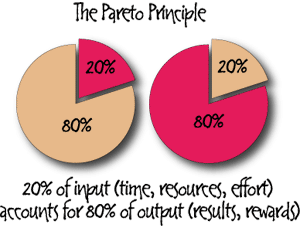
I had just google about Mr Pareto and found the below description:
++ Qte ++
...better known as the 80-20 rule, is based on the fact that 80% of what we achieve well is from 20% of what we do. This principle is more commonly applied to business efficiency but can be applied just as easily to any aspect of our day to day lives.
Successful people achieve more by concentrating on the 20% that matters. This means that we can eradicate up to 80% of activity during our daily routine that does not contribute towards our success by starting to do less. If you look at most successful people in the workplace, they are not the ones running around chasing their tail, staying all hours and making sure everyone else around them knows exactly how much they have to do. These people are successful because they concentrate on what matters. People who are always 'busy' are not necessarily effective. We often create a lot of work for ourselves because we don't stop to focus on what’s important.
The same is true about the rest of your life. Consider the things you do each day and think carefully about whether they need to be done or are adding any value to your life. If things are adding no value whatsoever, think about why you still do them? Maybe it's just a habit or maybe it seems important on the surface but is not really benefiting you or anyone else when you take a closer look? The best question to ask yourself is 'what is the positive or negative impact on myself or others if I stop doing this task / activity?' If the answer is 'none' then it is adding no value whatsoever.
Don't get me wrong - sometimes we all enjoy doing tasks or activites that don't seem to produce any real significant benefits but there is a benefit nonetheless and that is the fact that we are enjoying doing it! Spending time doing things we enjoy, no matter how trivial they may seem is always a benefit!
Don't underestimate the power that the awareness of the 80-20 rule can have on your life. Anyone who cuts out everything that has no benefit is one hellava disciplined person but if freeing up just some of your time each day from the mundane and insignificant means you can spend more of your time on the things that will benefit you and those around you then it is well worth considering!
++ Unqte ++
Extracted from
Friday, December 4, 2009
2 lessons learnt
I received a call this evening and saw an email when I reached home. Both of them saw my blog articles.
Mr Chew called and lectured me that I did not follow up on his proposal and expect him to remind me that he is interested to buy some insurance. No matter how good my advisory ability is, if I lacks the sales instinct, I'll not survive. He reminded me to remember the parato principal and categorise my clients.
From the call, I realised that I had spent too much time fighting fire without realising that I had forgotten to harvest my corps. What he lectured about me are right and I must wake up.
As for the email I received, it had hit me hard too. "Confidence" is the word.
++ Qte ++
Dear Adrian,
I chanced upon your blog and decide to invest 5 minutes on you.
I will not comment on your capability or intelligence but I think you lack self esteem. You can read some motivation books to change your mindset and to regain confidence.
Only when you start believing in yourself, your career will pick up and attract positive people to buy insurance from you. I think your industry is about building trust and with confidence, people will feel it and will trust you more. Successful people are not necessarily intelligent, they can be simple people who are just more confidence than the rest.
You don’t looks very old to me. Try 2 more years and see if this industry suits you. Find successful agents, stick to them and learn from them. Be a child again and find out when you lost your self esteem. Start loving, believing and trust yourself.
God bless.
Vincent
++ Unqte ++
(I shall close on this topic and keep this article to remind myself what I went through. I will do well and 2010 will be the year.)
Mr Chew called and lectured me that I did not follow up on his proposal and expect him to remind me that he is interested to buy some insurance. No matter how good my advisory ability is, if I lacks the sales instinct, I'll not survive. He reminded me to remember the parato principal and categorise my clients.
From the call, I realised that I had spent too much time fighting fire without realising that I had forgotten to harvest my corps. What he lectured about me are right and I must wake up.
As for the email I received, it had hit me hard too. "Confidence" is the word.
++ Qte ++
Dear Adrian,
I chanced upon your blog and decide to invest 5 minutes on you.
I will not comment on your capability or intelligence but I think you lack self esteem. You can read some motivation books to change your mindset and to regain confidence.
Only when you start believing in yourself, your career will pick up and attract positive people to buy insurance from you. I think your industry is about building trust and with confidence, people will feel it and will trust you more. Successful people are not necessarily intelligent, they can be simple people who are just more confidence than the rest.
You don’t looks very old to me. Try 2 more years and see if this industry suits you. Find successful agents, stick to them and learn from them. Be a child again and find out when you lost your self esteem. Start loving, believing and trust yourself.
God bless.
Vincent
++ Unqte ++
(I shall close on this topic and keep this article to remind myself what I went through. I will do well and 2010 will be the year.)
Thursday, December 3, 2009
One terrible client I remembered
Writing the previous post reminded me of one client that I met few years ago. From this, you may be able to see how stupid and easily bullied I am.
James(Not real name) had taken up a $32.50 endowment policy from me through the Army camp talks that I went. 2 months later, the policy went through and policy sent to him.
3 months later, I was on duty in NTUC Income Centre and a man rushed in to find Adrian Khiat. I went up to meet him and to understand what the problem was as I had never met that guy before. I got to know what he is Jame's Father.
He was shouting at me at the NTUC Income counter over "Why I did not help James apply for a NTUC Link Card after the policy was approved." He really scolded me and said that I had caused him inconvenience over his inability to get the linkpoints when he do his shopping the next day. I was quite sad and I put all blame on myself as if I'm wrong. I blamed myself for being incompenent and for not calling all those Army Boys from that particular BMT Company if they wants a linkcard after policy approval.
I remembered that it was a Friday and he wanted me to get down to his place at Whampoa Drive early Saturday morning 9:30am and wants me to go shopping with him. He wants to use my linkcard with my presence and I have to reimburse whatever linkpoint savings I got from his purchases.
I thought I was in the wrong for "NOT HELPING JAMES APPLY NTUC LINKCARD" and I really make my way down to Whampoa at 9:30am sharp. I called his hp and he told me to wait downstairs. I waited for more an hour and called again. He told me that he decided not to go shopping already and tell me to go back home.
Thinking back, I know I'm stupid but back then, I was depressed as if I'm such a lousy adviser for not helping James with the Linkcard. I think I take too much responsibility upon myself most of the time and I will feel very sad when I disappoint someone else. I'm not surprised if the next person use the same tone to shout at me today and I'll do the same thing because I may not know how to reject the person when they insist their way. Is it true that nice people will just get bullied or I'm simply stupid?
James(Not real name) had taken up a $32.50 endowment policy from me through the Army camp talks that I went. 2 months later, the policy went through and policy sent to him.
3 months later, I was on duty in NTUC Income Centre and a man rushed in to find Adrian Khiat. I went up to meet him and to understand what the problem was as I had never met that guy before. I got to know what he is Jame's Father.
He was shouting at me at the NTUC Income counter over "Why I did not help James apply for a NTUC Link Card after the policy was approved." He really scolded me and said that I had caused him inconvenience over his inability to get the linkpoints when he do his shopping the next day. I was quite sad and I put all blame on myself as if I'm wrong. I blamed myself for being incompenent and for not calling all those Army Boys from that particular BMT Company if they wants a linkcard after policy approval.
I remembered that it was a Friday and he wanted me to get down to his place at Whampoa Drive early Saturday morning 9:30am and wants me to go shopping with him. He wants to use my linkcard with my presence and I have to reimburse whatever linkpoint savings I got from his purchases.
I thought I was in the wrong for "NOT HELPING JAMES APPLY NTUC LINKCARD" and I really make my way down to Whampoa at 9:30am sharp. I called his hp and he told me to wait downstairs. I waited for more an hour and called again. He told me that he decided not to go shopping already and tell me to go back home.
Thinking back, I know I'm stupid but back then, I was depressed as if I'm such a lousy adviser for not helping James with the Linkcard. I think I take too much responsibility upon myself most of the time and I will feel very sad when I disappoint someone else. I'm not surprised if the next person use the same tone to shout at me today and I'll do the same thing because I may not know how to reject the person when they insist their way. Is it true that nice people will just get bullied or I'm simply stupid?
Getting complained
One Client just called me and passed a lot of negative remarks on me. I felt so lousy now. Why I always allow others to scold me again and again.
Her son was borned prematured on 19th October. She called me to sign up an Shield Plan for her son on 1st November. The case was submitted on 4th November and insurer acknowledge it on 10th November. Probably that her son was borned prematured and his weight was very low, the underwriting took a bit longer and cannot be approved by 15th of November and hence policy cannot be commenced by 1st December. The earliest date of commencement will be on the 1st January.
She insisted that I told her that the policy will commence on 1st December and now probably going to complain against me for misrepresentation that I'd promise a 1st December commencement date for her baby.
I felt sad and frustrated with all these Shield Plans. Heavy Administration work, Very problematic and stringent underwritings, very easy to claim, earn peanuts and get scolded. I also lost a prospect as I look forward helping them with a more detailed planning.
Her son was borned prematured on 19th October. She called me to sign up an Shield Plan for her son on 1st November. The case was submitted on 4th November and insurer acknowledge it on 10th November. Probably that her son was borned prematured and his weight was very low, the underwriting took a bit longer and cannot be approved by 15th of November and hence policy cannot be commenced by 1st December. The earliest date of commencement will be on the 1st January.
She insisted that I told her that the policy will commence on 1st December and now probably going to complain against me for misrepresentation that I'd promise a 1st December commencement date for her baby.
I felt sad and frustrated with all these Shield Plans. Heavy Administration work, Very problematic and stringent underwritings, very easy to claim, earn peanuts and get scolded. I also lost a prospect as I look forward helping them with a more detailed planning.
Wednesday, December 2, 2009
B1 or A1 ward?
I was talking to one of my client last week whose teenage son was discharged from KK Hospital recently. His son stayed in B1 ward over 3 days, which is 4-beds per room ward.
He complained that he really regretted choosing the B1 ward and wants to upgrade his Medical Insurance asap. I told him that it will be very very tough for his son to get a shield plan upgrade considering that he was just discharged from hospital and need months before full recovery. He was more disappointed that he could not claim a single cent because the bill was within the deductible of $2,000.
Beside his son's bed was another boy. The boy comes from a Malay Family. They have 4-5 siblings sitting around, even on the floor day to night, making a lot of noises. The parents bought nasi lemak to the hospital room for the kids and the room was filled with smell of food and chilli. During the night, they have large group of friends and visitors coming to the room as if there is a party. My client and son was very irritated.
Well. I think this is one difference between a A1 and B1. I think C wards can be even more interesting if you are lucky. For me, I have the choice to stay wherever I like if I'm really hospitalised, including going to Private Hospitals if there is a famous doctor or surgeon there which I want to seek treatment.
Do you have a choice?
He complained that he really regretted choosing the B1 ward and wants to upgrade his Medical Insurance asap. I told him that it will be very very tough for his son to get a shield plan upgrade considering that he was just discharged from hospital and need months before full recovery. He was more disappointed that he could not claim a single cent because the bill was within the deductible of $2,000.
Beside his son's bed was another boy. The boy comes from a Malay Family. They have 4-5 siblings sitting around, even on the floor day to night, making a lot of noises. The parents bought nasi lemak to the hospital room for the kids and the room was filled with smell of food and chilli. During the night, they have large group of friends and visitors coming to the room as if there is a party. My client and son was very irritated.
Well. I think this is one difference between a A1 and B1. I think C wards can be even more interesting if you are lucky. For me, I have the choice to stay wherever I like if I'm really hospitalised, including going to Private Hospitals if there is a famous doctor or surgeon there which I want to seek treatment.
Do you have a choice?
Monday, November 30, 2009
Is regular premium policies affected by 1st Apr 08 CPF ruling?
Just some sharing of a question that I was asked today.
"I have only $12,000 left in my Ordinary Account now and I have a regular premium Endowment plan which I used CPFOA since 1995. Will I be affected by the $20,000 cap set by CPF Board in April 2008? Must I use cash to pay for the premium if I am to continne with this plan?"
The answer is "No". You can also continue to pay for your agent bank fee and to service the future premiums of your regular premium insurance policy even if your Ordinary Account balance falls below $20, 000 after the 1st April 08 Ruling.
However, this does not apply to recurring single premium insurance policies or regular savings plans for unit trusts.
"I have only $12,000 left in my Ordinary Account now and I have a regular premium Endowment plan which I used CPFOA since 1995. Will I be affected by the $20,000 cap set by CPF Board in April 2008? Must I use cash to pay for the premium if I am to continne with this plan?"
The answer is "No". You can also continue to pay for your agent bank fee and to service the future premiums of your regular premium insurance policy even if your Ordinary Account balance falls below $20, 000 after the 1st April 08 Ruling.
However, this does not apply to recurring single premium insurance policies or regular savings plans for unit trusts.
Sunday, November 29, 2009
6 claims this week!!!
It was a busy and stresful week for me but unfortunately nothing to do with income generating but time taken away from me to generate more income.
I don't know what happened this week. I normally receive one to two claims per month but this week, I received six!!! My zodiac star probably went out of position.
4 Incomeshields, 1 Personal Accident and 1 motor.
For the Shield Plans,
1 due to H1N1 in Malaysia (2 yr old boy)
1 due to Piles Removal
1 due to Prostate Enlargement
1 due to a 3 days Observation (Weak Heart and bloated stomach)
For the Accident Plan, the child fractured his finger
For the Motor Plan, its a 3rd party claim against another driver.
For the H1N1 case, I received so many calls from the worried mother in Malaysia asking if his insurance is claimable, asking what I need to get from doctor, asking if I need to send her form, etc. For the rest, they all called me to ask if the insurance is claimable.
I was very stressful to be asked "My insurance can claim or not?" because I cannot be absolutely sure everytime and I'll be stress until the payout is made.
For the Motor case, I'm also stressed because the accident happened in the early morning 7:30am when I'm still in bed. My client sounds agitated and asked me what to do at the scene of accident. I had a very late night and was very tired. It took half a day before his car are sent to the workshop and he kept calling me from time to time.
Claims is part and parcel of our profession and I very sure that I'm probably doing more claims than other advisers due to the large no. of Shield and PA clients that I have. I know the type of common claims and I have a good idea on the type of bills to be expected. For certain medical conditions, the bill can still be sizeable even when you choose the B2 ward. Medishield alone might not protect you adequately. I'm speaking from my personal experience and I hope you can be proactive in ensuring that you get protected early.
I don't know what happened this week. I normally receive one to two claims per month but this week, I received six!!! My zodiac star probably went out of position.
4 Incomeshields, 1 Personal Accident and 1 motor.
For the Shield Plans,
1 due to H1N1 in Malaysia (2 yr old boy)
1 due to Piles Removal
1 due to Prostate Enlargement
1 due to a 3 days Observation (Weak Heart and bloated stomach)
For the Accident Plan, the child fractured his finger
For the Motor Plan, its a 3rd party claim against another driver.
For the H1N1 case, I received so many calls from the worried mother in Malaysia asking if his insurance is claimable, asking what I need to get from doctor, asking if I need to send her form, etc. For the rest, they all called me to ask if the insurance is claimable.
I was very stressful to be asked "My insurance can claim or not?" because I cannot be absolutely sure everytime and I'll be stress until the payout is made.
Once payout made, I'll need to help clients with the pre and post hospitalisation bills. This is when the busy time comes. For some cases, I will need to bring claim form, fill up for them and monitor the claims process.
For the Motor case, I'm also stressed because the accident happened in the early morning 7:30am when I'm still in bed. My client sounds agitated and asked me what to do at the scene of accident. I had a very late night and was very tired. It took half a day before his car are sent to the workshop and he kept calling me from time to time.
Claims is part and parcel of our profession and I very sure that I'm probably doing more claims than other advisers due to the large no. of Shield and PA clients that I have. I know the type of common claims and I have a good idea on the type of bills to be expected. For certain medical conditions, the bill can still be sizeable even when you choose the B2 ward. Medishield alone might not protect you adequately. I'm speaking from my personal experience and I hope you can be proactive in ensuring that you get protected early.
Subscribe to:
Posts (Atom)

